
You’ve decided this is the year to implement a Culture of Reading because you know why reading for pleasure matters. You’ve seen the research, you’ve felt the urgency, and you’ve probably had the conversation about declining reading scores more times than you can count. But knowing why your school needs to implement a Culture of Reading is the easy part. The harder question is: where do you actually start on a Monday morning, in between hallway duty, lesson plans, and everything else already on your plate?
That’s the gap this guide is built to close. We’re moving from the “why” to the “how,” drawing on Dr. Lorraine Radice’s foundational book, Leading a Culture of Reading, and her exclusive professional development collaboration with BookBreak. Consider this your practical, six-part roadmap!
What Does a Real Culture of Reading Framework Look Like?
As an educator, if you’re looking to implement a Culture of Reading, you don’t need another abstract theory. You need actionable, realistic steps that actually fit into a hectic school day, and that’s exactly what Dr. Radice set out to provide. Her book has become a go-to resource for literacy leaders because it treats a Culture of Reading as something you build deliberately, not something you simply hope happens.
Dr. Radice partnered with our BookBreak team for an exclusive professional development session, merging her research with our own experience supporting schools. Together, we’ve distilled the work into six categories schools can use to intentionally implement a Culture of Reading, one deliberate step at a time: school-wide campaigns, staff role models, sustainability systems, student leadership, author connections, and family engagement.
How to Launch a School-Wide Reading Campaign Students Actually Want to Join
If you missed it, our earlier post What Is a True Culture of Reading? is a good primer before you dive in here. The first step to implementing a true Culture of Reading starts with a shared, high-energy experience that gets the entire building talking about books. That means moving past compliance checklists and quiet reading logs, and instead launching vibrant, inclusive reading themes and friendly school-wide competitions that students actually look forward to.
Just as important: celebrate consistency, not only completion. Students don’t need to finish a certain number of books to feel like part of a school’s Culture of Reading; they need to feel seen and celebrated for showing up. Recognizing every student who reads 10-15 minutes a day, regardless of title or reading level, builds a stronger reading identity than celebrating only the fastest or most prolific readers. That shift, from “who read the most” to “who’s building the habit,” is often what makes a campaign inclusive instead of intimidating. A simple sticker chart or hallway shout-out board works just as well as anything fancy; the point is visibility, not budget.
Planning a school-wide reading initiative from scratch does take real time, though, especially around events like One Book/One School, Book Tastings, or a Literacy Night. If you’d rather not build one from the ground up, BookBreak’s Literacy Event Toolkits and structured Reading Challenges give you a ready-made starting point you can adapt to your own building.
How Do You Build a Team of Reading Role Models?
In order to successfully implement a strong Culture of Reading, students need to see that reading is a lifelong joy, not just a school requirement, and the fastest way they learn that is by watching the adults around them. When teachers, custodians, administrators, and cafeteria staff visibly share what they’re currently reading, students absorb a quiet but powerful message: reading is for everyone and it’s worth being a part of.
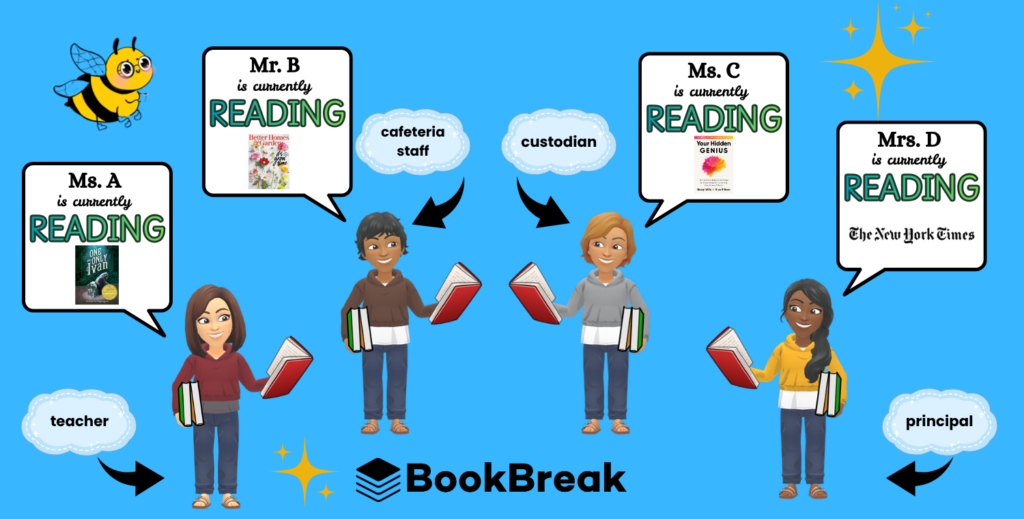
Encourage every adult in your building, not just classroom teachers, to display their Current Read somewhere students will notice it. A sticky note on an office door or a “What I’m Reading” sign at the front desk works because it’s small, sustainable, and visible, and you can make one with whatever’s already on hand in your supply closet. The key is to keep it simple for staff to display their reading preferences and promote literary community spaces in every classroom, hallway, and office.
How Do You Sustain a Reading Culture Through the Mid-Year Slump?
When it comes to implementing your Culture of Reading, here’s the honest part: the biggest obstacle to any new initiative isn’t the launch. It’s month four, when the initial excitement wears off and the calendar fills back up with everything else. A true Culture of Reading requires systems that keep the momentum alive well after the kickoff assembly.
You don’t need a special tool to start. A quick pulse-check, a five-question survey to staff and students asking what’s working and what’s gone quiet, will tell you where your culture is thriving and where it’s lagging. Pair that with a seasonal refresh of your library and classroom displays (new book-face-outs, an updated staff “currently reading” board, a rolling cart of books on display for the season) to keep the environment from going stale. Put both on a recurring calendar reminder now, before the excitement fades, so sustaining your Culture of Reading doesn’t depend on remembering to think about it later.
If you’d rather not build that pulse-check from scratch, BookBreak’s Culture of Reading Diagnostic does the same job for you, paired with included resources and materials like posters and bulletin board kits for the seasonal refresh.
How to Turn Students Into Literacy Leaders, Not Just Readers
Sustainable implementation for your Culture of Reading truly takes root when students stop being passive participants and start actively driving the literary conversation themselves. That shift from “students who read” to “students who lead reading” is what makes the culture self-sustaining.
A University of Northern Iowa study of middle schoolers’ book-selection habits found that more than half of students preferred choosing books by browsing and talking with a friend or classmate, and about half responded positively to student-produced shelf-talkers, the brief handwritten recommendation notes left on library shelves. In other words, peer recommendations move books off shelves in a way adult recommendations often can’t.
Give students a real voice through peer-to-peer book recommendations, student-led book clubs, and creative classroom discussions, and then get out of the way. A simple shelf-talker template or a rotating “student pick” shelf costs nothing and does most of the work. For a starting point on the conversation piece, our Would You Read It? video series works well to spark student-led media panels, keeping students firmly in the driver’s seat.
How to Bring Author Visits Into Any Classroom (Without the Budget or Logistics)
Booking an author to visit your school is a great goal for implementing your Culture of Reading. Nothing transforms a child’s relationship with text faster than meeting the real person behind the pages. A 2019 National Literacy Trust study of nearly 57,000 UK students found that kids who’d had an author visit their school were roughly twice as likely to read above their expected age level and reported significantly higher reading enjoyment and confidence than peers who hadn’t had a visit.
Unfortunately, booking authors the traditional way requires thousands of dollars, months of coordination, and logistical headaches most already-stretched staff simply don’t have time for. Reaching out directly to an author’s publisher, checking whether a local or debut author will do a free or low-cost virtual chat, or checking your public library’s programming calendar are all worth trying first if budget is the real barrier.

If that legwork isn’t realistic this year, this is the piece of the puzzle BookBreak was built to solve, and it’s how we started. We deliver two to three live, virtual author events every month to K-12 students. Each event is complete with pre-made lesson plans, plus an on-demand archive of past broadcasts you can pull from anytime. From elementary read-alouds to our high school Classic Connections videos, BookBreak brings world-class storytellers directly to your students with supporting resources done and ready to use.
How to Get Reading Culture Home: Engaging Families and Caregivers
To permanently implement a Culture of Reading, the love of books has to travel home in a student’s backpack. That means giving students and their families realistic, stress-free ways to encourage reading for pleasure, regardless of how packed their evenings already are.
This goes beyond vocabulary. Everyday moments at home, bedtime stories, family talk, dinner conversation, build the kind of deep comprehension skills structured drills can’t reach, according to research published in American Educator. Reminding families that a Culture of Reading doesn’t require an assigned text, just conversation and shared time on a book of their choice, can lower the barrier significantly. A one-page take-home flyer with three or four easy conversation starters, sent home once a month, is often all it takes.
For schools that want that piece handled for them, BookBreak’s Family Literacy Resource Center and School-Home Connection toolkits send out monthly newsletters, curated reading lists, and practical guides designed to support even reluctant readers at home, so nobody on staff has to draft one from scratch.
Your Next Step: Building a Reading Culture That Lasts
Implementing a true Culture of Reading doesn’t require reinventing the wheel, and it doesn’t require a subscription to anything. It just requires the right framework, applied consistently. You already have the passion to change your school’s DNA; these six categories give you the roadmap to act on it, and every one of them is doable with what your school already has on hand.
If you’d rather not carry the load alone, that’s what BookBreak’s Culture of Reading platform is there for, turning Dr. Radice’s implementation strategies into easy, plug-and-play realities for your school when you want the extra support.
Stay Tuned…