Back-to-school season is chaotic enough without adding elaborate literacy prep to the pile. Between changing rosters, new schedules, and a million logistics to sort out before the first bell, the last thing busy educators need is a literacy plan that demands hours of planning time they don’t have. That’s exactly why building a few low prep literacy strategies into your first weeks back is one of the highest-leverage moves you can make all year.
Picture two versions of the same first week:
- Teacher A spends her evenings printing packets and building a rubric for an elaborate welcome-back project.
- Teacher B spends five minutes at the end of each day running a routine she’ll reuse for the rest of the year.
Ultimately, only one of those approaches survives October.
Low prep literacy strategies that begin the first week set you up for routines that can last the whole year, and we have a free download that checks that box (you’ll find it in the 3-2-1 Exit Ticket section below). Keep reading for what actually separates low prep from no rigor, a few zero-prep strategies you can start using tomorrow, and that free download.
The Back-to-School Bandwidth Crunch: Why Low Prep Literacy Strategies Matter Right Now
Teachers and librarians have next to zero bandwidth in August and September for anything that requires heavy planning, extra materials, or a stack of grading.
According to RAND’s 2025 State of the American Teacher Survey, 46% of teachers said their job left them too tired for activities in their private life, compared with just 13% of similar working adults. In fact, that gap tends to be widest in the first weeks of the year, before any routines exist yet.
Reasons for this extend beyond the bell schedule and the calendar. The first weeks of school are also when students are most unsure of the routines and most anxious about a new classroom, so an elaborate first-week project with a long rubric can add stress instead of easing it. That’s why overcomplicating early literacy work with big projects or detailed rubrics burns everyone out before real routines ever have a chance to stick.
So what’s the alternative?
A small set of simple, repeatable low prep literacy strategies that launch on day one and keep running all year, long after the back-to-school adrenaline wears off.
What Makes a Literacy Strategy Truly Low Prep?
A truly low prep literacy strategy doesn’t mean lower rigor. It means removing friction, not lowering expectations. The bar isn’t how simple something looks. It’s how much of your limited time, mental energy, and materials it actually eats up.
A real low prep literacy strategy checks three boxes:
- It uses what’s already happening in your lesson. You are already teaching the lesson, so let’s find ways to weave the literacy strategy into it.
- It takes minutes, not a planning period, to set up. If prepping it takes longer than teaching it, it isn’t actually low prep.
- It works across any subject or lesson. A strategy you have to reinvent for every unit isn’t a routine. It’s more work (for you and your students) in disguise.
The teacher experience matters here too: a genuinely low prep literacy strategy should take less time to explain and run than it would to grade a single project.
Meanwhile, for students, simple, familiar formats and steady routines keep the focus on thinking and reading instead of decoding a complicated new set of instructions every time. Once the routine feels familiar, kids can focus on the content instead of the format. And isn’t that the whole point?
The Critical Shift: Why Low Prep Literacy Strategies Beat One-Time Events
First-day icebreakers, themed bulletin boards, and one big kickoff project are fun, but they don’t build lasting habits. They’re memorable, sure, but memorable isn’t the same as effective. By week three, most classrooms have moved on, and as a result, nothing from that first-week event carries forward.
Small, consistent practices work differently. Even just a few minutes, a few times a week, compound into real reading stamina, lasting relationships, and real trust over the course of a year.
That’s the shift worth making: the goal isn’t a memorable literacy event in week one. It’s a low prep literacy strategy students can count on every week after that. Consistency, not spectacle, is what actually moves the needle.
3 High-Impact, Zero-Prep Reading Strategies for Day One
In fact, you don’t even need to dive into your curriculum to start building reading habits this week. These three low prep literacy strategies work in any subject, any grade, and any classroom, starting tomorrow morning:
- Quick vocabulary pulls. Ask students to name one new word from the day’s reading or lesson. No worksheet required. No grading. Just a quick verbal or written pull as class wraps up.
- One-sentence summaries. Have students summarize what they just read or learned in a single sentence, shared aloud or jotted on a sticky note. It forces real synthesis in under a minute.
- Think-pair-share. A 60-second partner talk before any whole-class discussion builds comprehension and confidence. Research from Reading Rockets backs it as one of the more reliable ways to get every student thinking before anyone raises a hand.

Each of these works for the same reason:
- it’s repeatable
- it requires no special materials
- it fits into the last five minutes of any lesson
Ready for one you can hand students today without writing a single new worksheet?
The Free 3-2-1 Exit Ticket: A Simple Routine for Any Subject
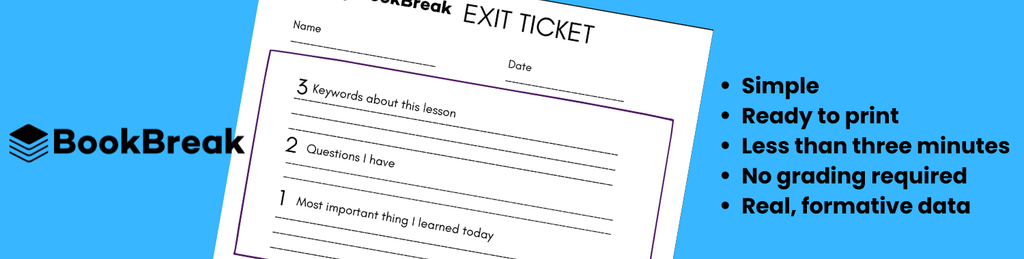
Our free downloadable 3-2-1 Exit Ticket is a simple, general-use check-in that works with any subject or lesson, any day of the year. No adapting required.
Quick Summary: The 3-2-1 Exit Ticket Routine
- 3 Keywords: Students list three essential vocabulary words or concepts from today’s lesson.
- 2 Questions: Students write down two lingering questions or points of confusion.
- 1 Takeaway: Students summarize the single most important thing they learned in one sentence.
Teacher impact: This simple, ready-to-print literacy strategy takes under three minutes, requires zero grading, and gives you real formative assessment data as the students leave the classroom.
It’s especially useful for back to school. It gives students who don’t know their new teacher yet an easy, low-pressure way to ask questions, while giving teachers a quick window into how each student is really doing. Starting the exit ticket routine in week one means it’s already a normal part of class by the time the real curriculum ramps up. This is exactly the kind of low prep literacy strategy worth locking in early.
Download the free BookBreak 3-2-1 Exit Ticket. Grab-and-go, ready to print, zero setup required.
How Daily Micro-Routines Build Lasting Student-Teacher Relationships
A low prep literacy strategy does more than save your evenings. Done consistently, it becomes the foundation for something bigger: real student-teacher relationships. In fact, small daily check-ins like the exit ticket give every student, even the quiet ones, a low-stakes way to be seen and heard by their teacher every single day.
BookBreak wants to meet educators right in that place. From ready-made resources like the 3-2-1 Exit Ticket to live and recorded author talks, BookBreak has already taken on the heavy lift. Educators get low prep, high-impact tools designed by fellow teachers and librarians.
In addition, as part of BookBreak’s growing Culture of Reading platform, these resources are built to help you build both stronger readers and stronger relationships, starting the very first week of school.
Ultimately, a low prep literacy strategy started during week one can become the routine that carries your whole year. Don’t spend your first weeks reinventing the wheel. Instead, a few simple, repeatable strategies now can save you hours later and build the kind of classroom relationships that make everything else easier.
Stay Tuned…