The benefits of a Culture of Reading in response to the rising literacy crisis probably sound like a no-brainer to most educators. However, once it becomes clear that a Culture of Reading goes much deeper than a few one-off literacy events each school year, we may need to look a little deeper into the reasons why every school needs a vibrant and sustainable Culture of Reading.
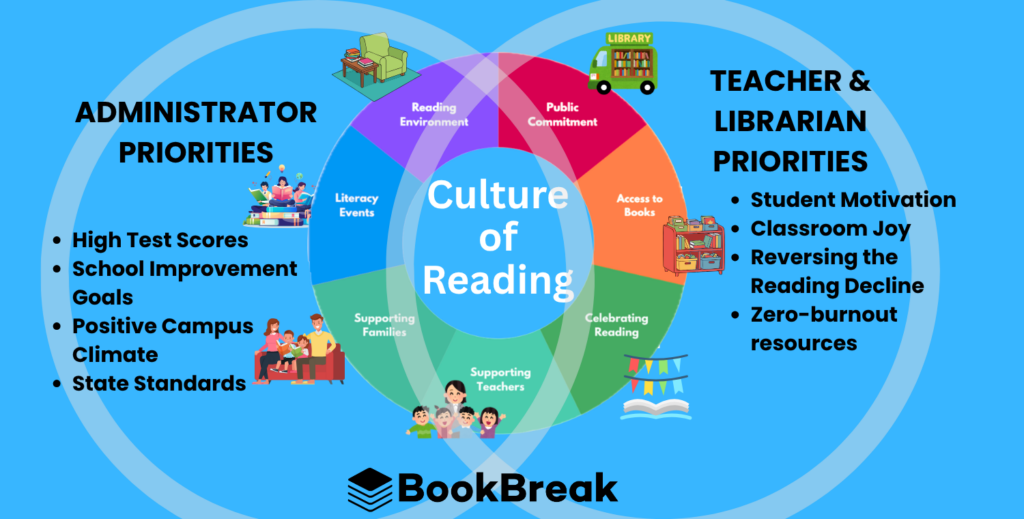
Every day, school leaders and classroom educators walk a challenging high-stakes tightrope between meeting strict academic mandates and the ever-present literacy crisis and fostering real-world student engagement. While administrators must focus heavily on tracking proficiency metrics, teachers and librarians fight a daily battle to keep distracted students focused on books and academic content. Fortunately, creating a Culture of Reading serves as the ultimate win-win solution for the entire school community. Because this environmental approach builds deep intrinsic motivation, it simultaneously drives up the test scores administrators are looking at and brings the genuine joy of books and reading back to our classrooms.
The Admin Angle: Addressing the Literacy Crisis Through a Culture of Reading
To effectively combat the literacy crisis, school administrators must prioritize building a sustainable Culture of Reading that aligns with broader school improvement goals. School administrators carry an incredibly heavy responsibility for tracking overall student outcomes, maintaining daily engagement, and fostering a positive school climate. To achieve these goals, leaders must look closely at how the school environment shapes student learning. Recent education research from UChicago Consortium on School Research emphasizes that a principal’s absolute greatest lever for school-wide academic gains is the proactive cultivation of a safe, supportive learning environment. Because the school environment dictates how students learn, building a strong Culture of Reading should never be an optional classroom activity. Instead it must be embraced as a powerful, overarching leadership initiative that transforms the entire building.
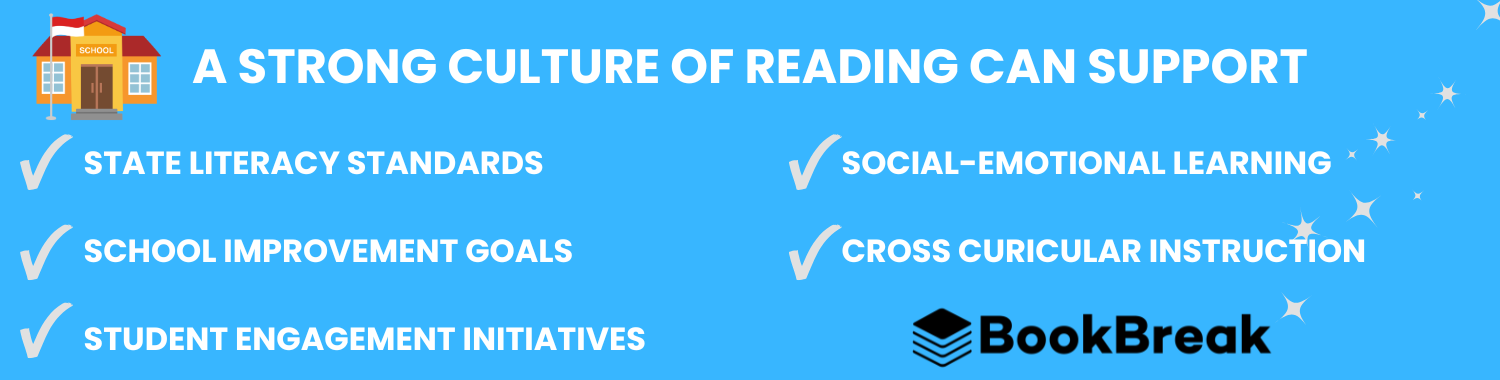
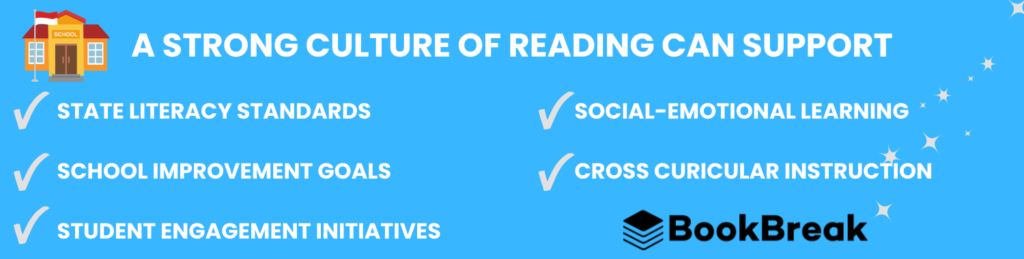
When leadership prioritizes an environmental shift, literacy initiatives naturally align with state standards, district literacy goals, and comprehensive school improvement plans. Investing in a unified Culture of Reading supports broad academic achievement and enriches cross-curricular learning. As a result, schools begin to see a noticeable increase in student performance across all core subjects, including science, social studies, and specialized areas.
The Hard Data: Boosting Academic Success and Test Scores
While the literacy crisis often feels overwhelming, the hard data shows that an active Culture of Reading is the most reliable path toward long-term academic success and higher test scores. While the emotional benefits of literacy are clear, we cannot ignore the hard data regarding standardized testing and long-term academic growth. Extensive historical data from organizations like the National Assessment of Educational Progress proves that true, authentic engagement with books is the most reliable and sustainable path toward long-term literacy development and higher test scores. When students have access to and actively enjoy books, they naturally develop superior reading comprehension across all content areas while implicitly sharpening their critical thinking skills.
Highlighting this strategy gives schools a proven framework to directly counteract stagnant or dropping standardized test scores. When a child routinely chooses to read for fun, their vocabulary grows exponentially. This rapid linguistic development translates directly into classroom confidence and long-term academic success across grade levels and content areas.
Reclaiming the Joy: A Culture of Reading Strategy for the Literacy Crisis
On the front lines of the literacy crisis, a school-wide Culture of Reading provides the necessary environment to reclaim the joy of books and reverse the decline in reading for pleasure. Teachers and librarians face a massive attention battle against hyper-stimulating digital screens and pervasive academic burnout. Because traditional methods often fall short, a comprehensive, school-wide focus provides the missing environment needed to motivate reluctant readers and get physical books back into their hands. For example, a compelling case study from Research in Middle School Level Education (RMLE-Online) shows that when an administrator makes reading a universal priority by providing structured, systematic reading time with zero tasks attached, the school successfully builds a tight-knit community of readers and significantly boosts overall student engagement.
We must intentionally shift away from rigid compliance metrics, such as forced reading logs or one-page book reports, to inspire authentic student motivation and a genuine love for literature. Within a true Culture of Reading, the daily choice isn’t simply whether to read or not to read. Instead, the real choice centers on what you read and how that shared reading experience connects you to a broader community.
By providing essential background knowledge and facilitating meaningful connections with authors, we can effortlessly hook students into complex topics. Ultimately, this support helps students see themselves as true readers and writers, which drastically improves their daily confidence in the classroom.
Visible Engagement: Addressing the Literacy Crisis with a Culture of Reading
By establishing a Culture of Reading that is visible and valued, schools can directly address the literacy crisis while transforming the overall school climate and community identity. A school culture that remains deeply rooted in daily literacy actively strengthens the overall school climate and builds a vibrant, positive school identity. Because of this shift in the environment, administrators do not have to rely solely on spreadsheets or digital data walls to measure success. Instead, leaders will literally be able to see active student engagement happening in real-time throughout the hallways, classrooms, and the library.
Hard numbers speak louder in a school board meeting, so it may occasionally feel tricky for data-driven leaders to trust what they are simply seeing with their own eyes. Fortunately, this high level of visible engagement will eventually reflect beautifully in the long-term proficiency data and quantitative measures that administrators need to present to district leaders. In addition, a thriving Culture of Reading seamlessly connects individual classrooms to the central library, while simultaneously bringing families and community together through shared, unforgettable literacy experiences.
How BookBreak Bridges the Gap Between the Literacy Crisis and a Culture of Reading
For any school struggling with the literacy crisis, BookBreak offers the essential tools needed to build and sustain a thriving Culture of Reading. For any school-wide cultural shift to succeed over time, the implementation must remain highly manageable for busy teachers and easily scannable for administrators. This is exactly where the BookBreak’s full Culture of Reading platform bridges the gap between strict accountability metrics and pure student motivation. Our comprehensive platform provides the rigorous lessons, high-quality resources, and exact curriculum alignments that satisfy state standards and complex school improvement goals.
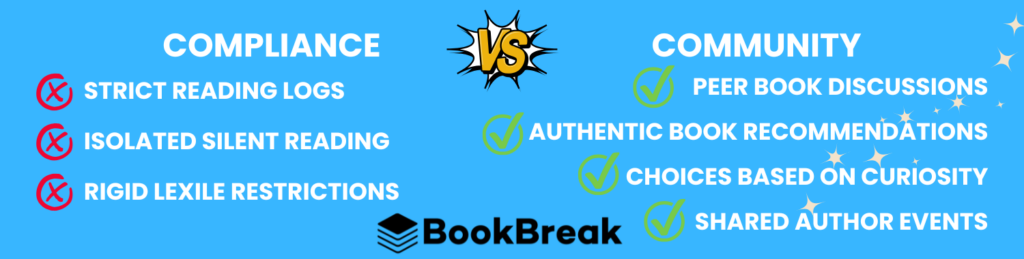
Through dynamic live and recorded author events, targeted mini-lessons, school-wide reading celebrations, family and community resources, and engaging reading challenges, BookBreak quickly hooks students and systematically addresses the decline in reading for pleasure without adding to widespread teacher burnout. School administrators can comfortably help scale and sustain a vital literacy initiative because the BookBreak team has already handled all the logistics, scheduling, and resource creation behind the scenes. By turning compliance into a community celebration, we make it simple for your school to meet its data goals while keeping the magic of storytelling alive.
Bringing a Culture of Reading to Life in Your School
Building a Culture of Reading is the most effective way to solve the literacy crisis, but it requires intentional effort from educators, librarians, and administrators working together. Ultimately, a thriving Culture of Reading never happens by pure accident or luck. It grows intentionally when dedicated educators, passionate librarians, and supportive administrators work together to make books and reading visible, valued, and celebrated across the entire school community.
If you are ready to stop doing literacy compliance checks and start building a community of active, joyful readers, let our team support you as you revitalize your curriculum and transform your school’s structural DNA from the inside out.
Stay Tuned for more on a Culture of Reading…