“Did you like it?” or “How was your book?” are often the go-to questions we ask when we want to help students talk about the book in their hand or ask questions about a book they’ve just finished.
We’ve all asked them, and we’ve all gotten the one word answers, “yes” or “fine”. As a result, the conversation about the book was over before it began. And the opportunity to connect over reading quietly disappears.
When we rely on broad, closed-ended questions, kids often default to “good,” “it was okay,” or “I don’t know.” So let’s change the questions we ask, and we can spark richer conversations that feel natural instead of forced. If you’re looking for a simple way, as a teacher or as a parent, to have a deeper conversation about the books students are reading, start with a shift in the questions.
Instead of asking for a summary or a rating, ask questions that invite thinking, wondering, and connecting. Questions shape conversations, so even small changes can open the door to a whole different discussion.
Why Talking About Books with Students Matters
Talking about books with students goes deeper than comprehension. It builds identity, creates motivations, and strengthens stamina. Research consistently shows that discussion strengthens engagement and motivation. The Kids and Family Reading Report from Scholastic demonstrates that talking about books is one of the top reasons kids like reading aloud with someone. And literacy researcher John Guthrie’s work on reading engagement emphasizes that students read more, and with greater stamina, when they feel personally connected to what they read. Talking about books helps build that personal connection.
When students talk about books in a safe, curious-driven way, they begin to see themselves as readers. Discussion helps them process ideas, test out their opinion, and explore perspectives without fear of being wrong. Thoughtful questions place the emphasis on curiosity over being correct. So conversations about books become a way to explore ideas rather than a way to be assessed or evaluated.
20 Questions To Start A Book Conversation with Your Students
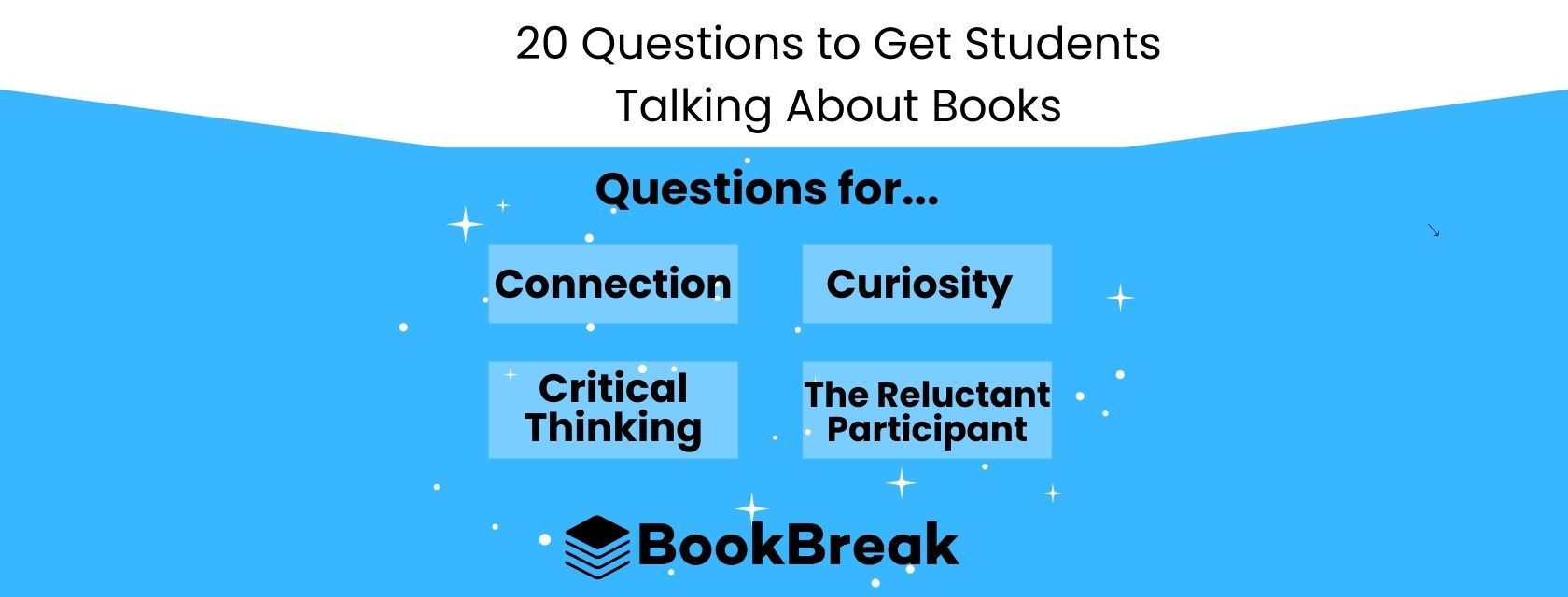
If students are going to build strong reading identities, we as parents and educators must find opportunities to talk about books in ways that feel meaningful and low-pressure. Here are four types of questions, with examples, that can help start the conversation.
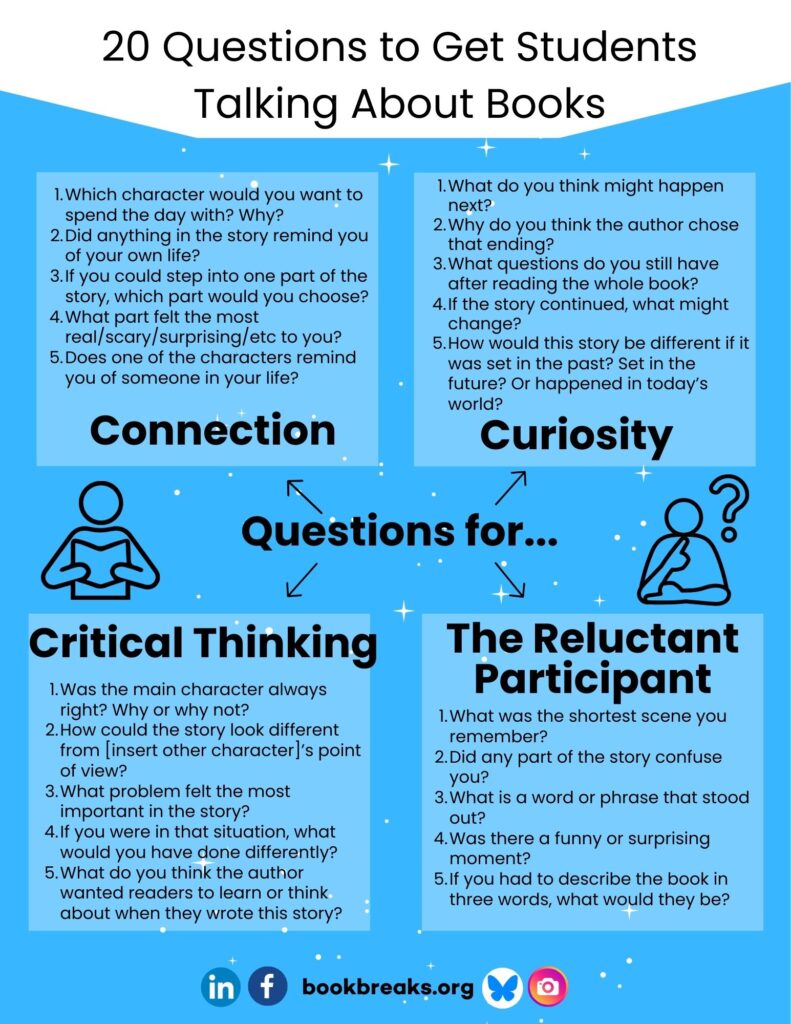
Questions To Encourage Connection to Books
This type of question is a great entry point for almost any reader:
- Which character would you want to spend the day with? Why?
- Did anything in the story remind you of your own life?
- If you could step into one part of the story, which part would you choose?
- What part felt the most real/scary/surprising/etc to you?
- Does one of the characters remind you of someone in your life?
These questions work well because they put connection at the center rather than recalling what happened in the plot. As a result, students will often respond more openly.
Questions that Encourage Curiosity About Books
This type of question will help invite wondering without “right” or “wrong” answers.
- What do you think might happen next?
- Why do you think the author chose that ending?
- What questions do you still have after reading the whole book?
- If the story continued, what might change?
- How would this story be different if it was set in the past? Set in the future? Or happened in today’s world?
These questions focus on possibility, so they reduce performance pressure and increase engagement with the conversation.
Critical Thinking Questions About the Reading
This type of question can help students explore other perspectives.
- Was the main character always right? Why or why not?
- How could the story look different from [insert other character]’s point of view?
- What problem felt the most important in the story?
- If you were in that situation, what would you have done differently?
- What do you think the author wanted readers to learn or think about when they wrote this story?
These questions do require deeper thinking, but they feel conversational when asked with genuine curiosity and in a conversation where others are also sharing their perspective.
Questions for the Reluctant Conversation Participant
This type of question can be helpful for students who are hesitant to have a conversation.
- What was the shortest scene you remember?
- Did any part of the story confuse you?
- What is a word or phrase that stood out?
- Was there a funny or surprising moment?
- If you had to describe the book in three words, what would they be?
These questions can lower the barrier that might be stopping a student from entering the conversation. Even reluctant readers can participate without feeling overwhelmed.
What if they say “I Don’t Know”
It happens. But it doesn’t have to mean the conversation is over.
- Try rephrasing the question to be simpler.
- Offer two choices: “Was it funny or serious?”
- Share your own answer first.
- Point out a specific moment: “What about when…”
- Circle back after they’ve had some time to think.
Often students need a little time to process. Stay patient. They will hopefully return with more to say.
5 Tips for a Natural Book Conversation
- Listen more than you talk. Pause and let them think.
- Follow their lead. If they light up about one particular detail, explore it further.
- Avoid correcting. Instead ask, “What makes you think that?”
- Share your own thoughts. Model how to be in the conversation and show how there is more than one way to answer these questions.
- Keep it short. A five minute chat is still a conversation!
Try to weave book conversations into natural moments. At school, it could be during independent work time or as students are entering the classroom for the day. At home, it could be car rides, dinner, or bedtime. Try to find moments that are relaxed.
Keep the Conversation Going
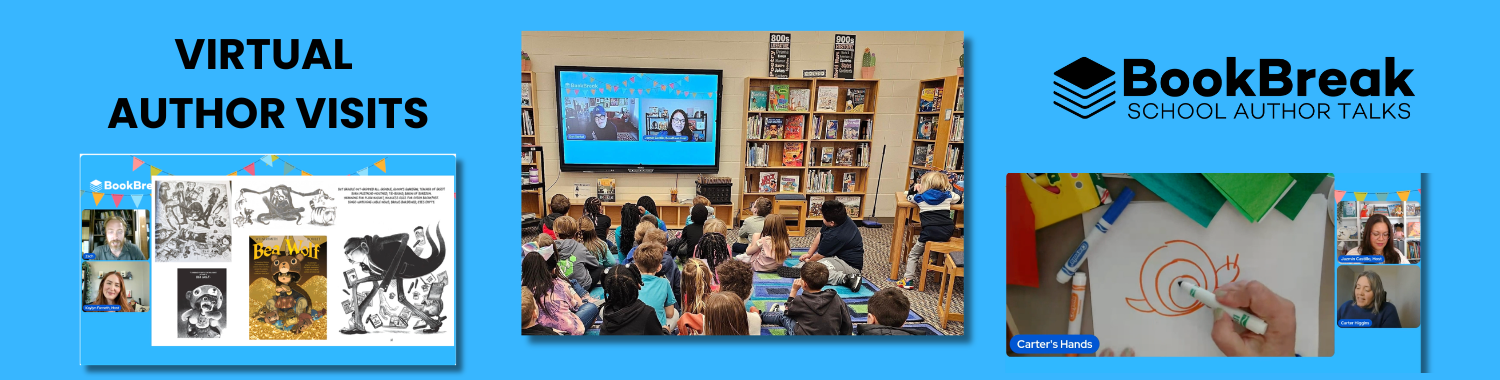
Incorporating author visits into the classroom can also give students something to talk about beyond “How was your book?” We can start to ask them, “What did the author say about writing that surprised you?” That will definitely open up a conversation, because authors have very interesting things to say!
At BookBreak, we connect students with live, interactive author talks that can be the beginning of a conversation or the reason that students keep talking after class. When students have the chance to hear the story behind the story, conversations will become easier.
If you are ready to learn more for your students or would like the teachers and librarians to explore how to bring author visits in, check out some of our samples and request a demo. You’ll start to see how BookBreak can support your reading culture.
Don’t forget to grab your FREE download of the 20 Questions!
Stay Tuned…